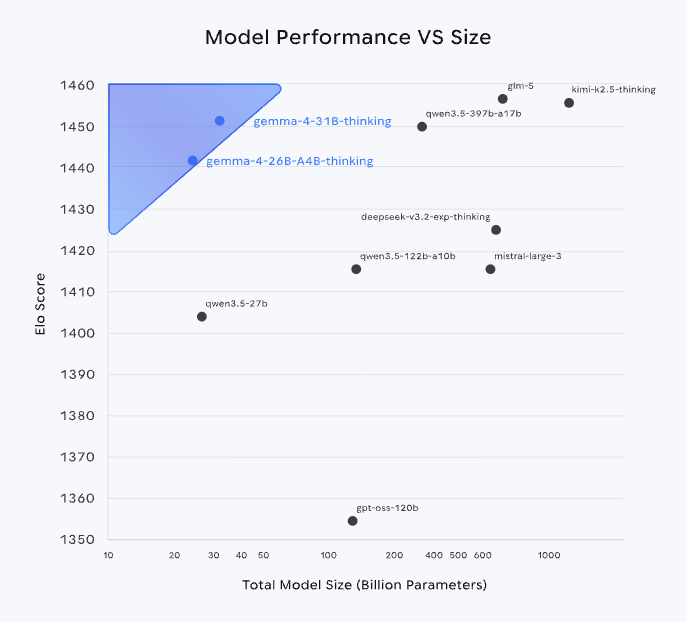
Production-grade Open LLM을 향한 아키텍처적 진화
Google이 공개한 Gemma 4 31B는 단순한 오픈소스 LLM의 확장이 아니라, 프로덕션 환경에서의 실제 활용을 전제로 설계된 모델이라는 점에서 기존 계열과 명확히 구분된다.
1. 모델 개요 및 설계 철학
Gemma 4 31B는 다음과 같은 특징을 가진다.
- 31B Dense Transformer 기반
- Instruction-tuned (it) 모델
- 256K Context Window
- Multimodal 지원 (Text + Image)
- Tool / Function Calling 대응 구조
- Apache 2.0 License
여기서 핵심은 단순한 성능 향상이 아니라,
다음과 같은 설계 목표가 반영되어 있다는 점이다.
“LLM을 단일 응답 엔진이 아닌, 시스템 구성 요소로 사용한다”
이는 기존 LLM이 갖던 “stateless inference” 중심 구조에서
stateful reasoning + tool interaction 기반 구조로의 전환을 의미한다.
2. 아키텍처 분석
2.1 Hybrid Attention Mechanism
Gemma 4는 표준 Transformer의 Full Attention 구조 대신,
다음의 혼합형(attention hybridization)을 채택한다.
- Local Sliding Window Attention
- Global Attention (selective token anchoring)
기술적 의미
- Time Complexity 감소
- Full Attention: O(n²)
- Hybrid: O(n · w) (w = window size)
- KV Cache 효율 개선
- 장문 입력 시 메모리 사용량 선형화
- Long Context 유지 능력
- 핵심 토큰(Global token)을 통해 semantic anchor 유지
결과적으로 해당 구조는 다음을 동시에 만족한다.
- Long context 처리
- Latency 제어
- GPU memory footprint 안정화
2.2 Long Context Processing (256K)
256K context는 단순 확장이 아니라
LLM의 사용 패턴 자체를 변화시키는 요소다.
기존 접근 방식
- Chunking
- Embedding + Vector Search (RAG)
- Context stitching
Gemma 4 기반 접근
- Direct ingestion
- Context-aware reasoning
- Reduced retrieval dependency
Trade-off
- KV Cache 증가 → GPU memory pressure 상승
- Attention window tuning 필요
- Latency 증가 가능성
따라서 실제 프로덕션에서는 다음 전략이 필요하다.
- Hierarchical context loading
- Sliding context window reuse
- Selective prompt compression
2.3 Multimodal Integration
Gemma 4는 Vision-Language 통합 구조를 갖는다.
특징
- 이미지 입력을 Transformer embedding space로 통합
- 텍스트와 동일한 reasoning path 사용
- 별도 pipeline 없이 multimodal 처리 가능
활용 영역
- OCR + semantic parsing
- UI state interpretation
- Monitoring dashboard 분석
이는 기존의
- OCR → NLP → Rule Engine
파이프라인을
- Multimodal LLM 단일 처리 구조
로 단순화한다.
2.4 Instruction & Tool Alignment
Gemma 4는 Agent 활용을 전제로 설계된 alignment 구조를 가진다.
주요 기능
- Structured Output (JSON)
- Function Calling
- System Prompt Control
내부 동작 (개념적)
- Prompt → Intent Parsing
- Reasoning → Tool Selection
- Function Call Generation
- Tool Response Integration
- Final Response Synthesis
이 구조는 기존 LLM을
“Text Generator” → “Execution Planner”
로 변화시킨다.
2.5 Reasoning Control (Thinking Tokens)
Gemma 4는 reasoning 과정의 제어가 가능하다.
- explicit thinking token 사용
- chain-of-thought 유도 가능
의미
- 추론 깊이 제어 (cost vs accuracy)
- deterministic behavior 향상
- 디버깅 가능성 확보
이는 특히 Agent 시스템에서 중요하다.
3. 시스템 아키텍처 관점 분석
3.1 기존 LLM 기반 구조
↓
API Gateway
↓
LLM Inference
↓
Response
3.2 Gemma 4 기반 구조
↓
Orchestrator (Agent Controller)
↓
LLM (Gemma 4)
↓
Tool Layer (API / DB / Infra)
↓
Execution Result
핵심 차이
- LLM이 “응답 생성”이 아닌 “의사결정 엔진” 역할 수행
- 시스템의 control plane 일부를 대체
| Gemma 4 31B | Gemma 4 26B A4B | Gemma 4 E4B | Gemma 4 E2B | Gemma 3 27B | |
| MMLU Pro | 85.2% | 82.6% | 69.4% | 60.0% | 67.6% |
| AIME 2026 no tools | 89.2% | 88.3% | 42.5% | 37.5% | 20.8% |
| LiveCodeBench v6 | 80.0% | 77.1% | 52.0% | 44.0% | 29.1% |
| Codeforces ELO | 2150 | 1718 | 940 | 633 | 110 |
| GPQA Diamond | 84.3% | 82.3% | 58.6% | 43.4% | 42.4% |
| Tau2 (average over 3) | 76.9% | 68.2% | 42.2% | 24.5% | 16.2% |
| HLE no tools | 19.5% | 8.7% | - | - | - |
| HLE with search | 26.5% | 17.2% | - | - | - |
| BigBench Extra Hard | 74.4% | 64.8% | 33.1% | 21.9% | 19.3% |
| MMMLU | 88.4% | 86.3% | 76.6% | 67.4% | 70.7% |
| Vision | |||||
| MMMU Pro | 76.9% | 73.8% | 52.6% | 44.2% | 49.7% |
| OmniDocBench 1.5 (average edit distance, lower is better) | 0.131 | 0.149 | 0.181 | 0.290 | 0.365 |
| MATH-Vision | 85.6% | 82.4% | 59.5% | 52.4% | 46.0% |
| MedXPertQA MM | 61.3% | 58.1% | 28.7% | 23.5% | - |
| Audio | |||||
| CoVoST | - | - | 35.54 | 33.47 | - |
| FLEURS (lower is better) | - | - | 0.08 | 0.09 | - |
| Long Context | |||||
| MRCR v2 8 needle 128k (average) | 66.4% | 44.1% | 25.4% | 19.1% | 13.5% |